
What does it mean to be digital? There are all these products and ideas and the concept of “analog and digital,” but what does it actually mean?
Well, for something to be digital, it must be resistant to noise. Noise is unwanted “stuff,” be that radio/TV static, or aging oil paint. A digital thing is good at cutting out or removing this noise, leaving a result with meaning regardless of change.
Another key aspect of a digital thing is that it has a fixed number of possibilities. Among the simplest examples of this is binary. Something is either a 0, or a 1. There are no 2s or 3s or 9s or 14s or any other number. Zeroes and ones. Another example is the English alphabet. The alphabet has 26 letters and 52 characters (lowercase and capital letters). This is a digital medium. An analog alphabet would have infinite letters, and would cease to carry legible meaning.
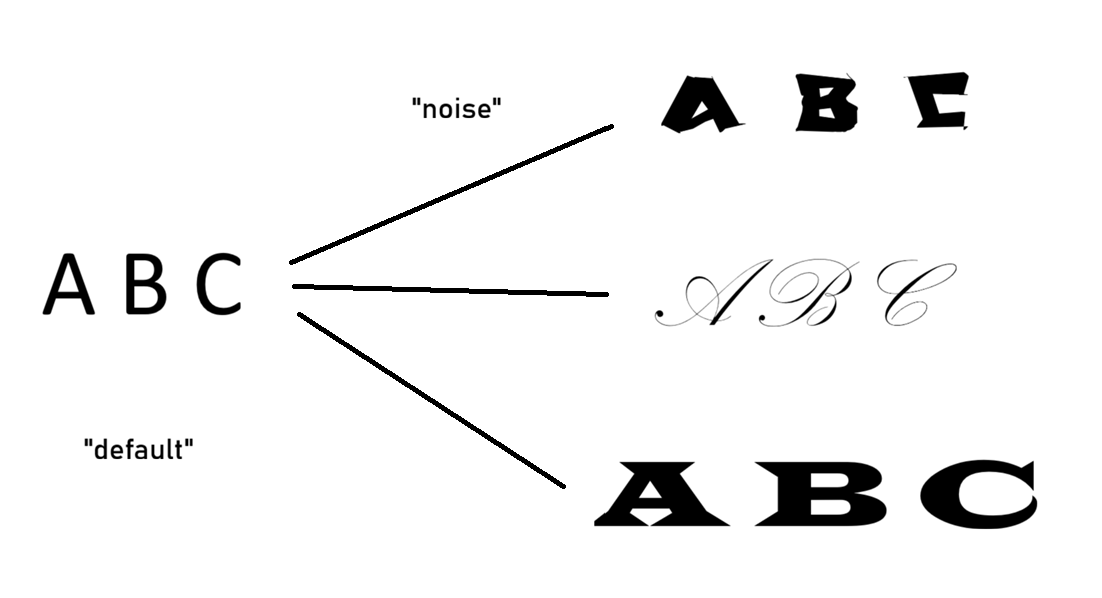
Here is a representation of how a digital alphabet works, and how it is resistant to noise. On the left we have a simple, regular typeface “A B C.” This is our “default,” unmodified, noise-free alphabet. We can subject this text to “noise” by changing the font. Now, each “A B C” looks different, but the letters still carry the same meaning. Were this an analog system, each of the three new font “A B Cs” would mean completely different things, as if they were different words entirely. A digital thing will maintain its meaning even through distortion.
Digital nature also applies to copies. Take the work(s) of William Shakespeare for example. His work(s) could live forever, remaining unchanged. But since it is a digital work written with a digital alphabet, it can be transcribed or copied (though avoid plagiarism please) as much or as often as it needs. From an information standpoint, the copy would be indistinguishable from the original work. A performance of one of Shakespeare’s plays is analog. The script is and will remain the same, but the interpretation and exact performance could have infinite possibilities. The tone of voices, the delivery of lines, the steps the actors take, all of this can change, and is one of infinite unique possibilities of the performance.
Hopefully this all makes sense! It can be a bit confusing at times, so be sure to check out my other posts on digital nature, the invention of our digital world, and some examples of digital inventions throughout history! Cheers!